A pomegranate is one of the more forgiving trees you can put in the ground, once it has decided to grow. The trouble almost always comes in the first twelve months, and it rarely comes from disease. It comes from a hole dug in a spot the tree doesn't like, a crown buried a few centimetres too deep, or a hose that ran generously for a week in April and never again.
None of those mistakes look dramatic on planting day. They surface two summers later, when the tree sulks, drops its flowers, and refuses to put on height. Getting the planting right costs you an afternoon. Here is how to spend that afternoon well.
Choose the Site Before You Choose the Tree
Pomegranates are Mediterranean by temperament. They want heat, light and air moving around them, and they want water to leave the soil quickly. Everything else is secondary.
Sun is the first test. Six hours of direct summer sun is the minimum; eight or more is what produces the ripe wood that carries next year's flowers. In cooler regions, plant against a south- or west-facing wall or fence. The stored warmth radiated back at night makes a real difference to how well the fruit colours up.
Drainage is the second test, and the one people underestimate. Pomegranates tolerate dry soil far better than wet soil. If your ground holds water in winter, the roots rot quietly and the tree dies in its second spring without obvious warning. Heavy clay is workable, but plant on a raised mound rather than in a basin.
- Avoid frost pockets. Low ground where cold air pools will catch the early flowers, and a late frost can wipe out a whole crop.
- Give it shelter from strong wind without boxing it in. Pomegranate branches are flexible but brittle where they join the trunk.
- Allow space to grow and to pick. A standard tree needs three to four and a half metres from walls, paths and other trees; a dwarf selection about two and a half.
- Keep it away from aggressive lawn. Grass roots compete hard with a young tree for both water and nutrients.
Dig the Hole and Prepare the Soil
Width matters more than depth. Roots spread sideways far faster than they go down, so dig a hole roughly twice the width of the root ball and about fifty to sixty centimetres deep. A hole sixty to seventy-five centimetres across is a sensible target for a young tree. Rough up the sides and the base with a fork: a spade leaves smooth, glazed walls that roots struggle to push through.
Keep the topsoil in one pile and the deeper soil in another. Then check the drainage before the tree goes in. Fill the hole with water and watch how long it takes to disappear. If it is still sitting there after several hours, plant on a mound of soil above the surrounding ground instead, or find another spot.
Mix the backfill with well-rotted compost — roughly one part compost to three of the native soil. That is enough to open up the texture without creating a rich pocket that encourages soft, sappy growth. Skip fertiliser entirely at planting. A new tree needs to establish roots, not push leaves.
Planting Depth and the Planting Sequence
More young pomegranates are killed by planting too deep than by any pest. The crown of the tree — the point where the trunk widens into roots — must sit at or slightly above the level of the surrounding soil. If your tree is grafted, keep the graft union five to ten centimetres clear of the soil line. Most pomegranates are grown from cuttings and are not grafted, so the crown itself is your reference point.
- Water the pot thoroughly an hour before planting, or soak bare-root stock for an hour or two.
- Tease out circling roots from a potted tree and trim any broken or dry ones with clean secateurs.
- Set the tree in the hole and check the crown height against a straight edge laid across the surface. Adjust the soil beneath the root ball until it is right.
- Backfill in stages, firming gently with your hands as you go. Never stamp on the soil; you will compact it into a brick.
- Build a shallow soil rim around the tree, about sixty centimetres out, to form a watering basin.
Take your time over step three. It is much easier to raise a tree by two centimetres now than to dig it up next spring.
The First Watering
Water slowly and thoroughly. Fifteen to twenty-five litres poured gently into the basin will settle the soil around the roots and close the air pockets that dry them out. Pour half, let it drain, then pour the rest. If the soil sinks noticeably, top it up so the crown doesn't end up in a dip that collects water.
Then mulch. A ring of straw, bark or dry grass five to eight centimetres deep will hold moisture and keep the soil temperature steadier through the first summer. Pull it back a hand's width from the trunk so the crown stays dry and ventilated.
Planting is the one day you can't repeat cheaply. Ten extra minutes with a straight edge and a spirit level of soil will save you a year.
Support for the First Two Seasons
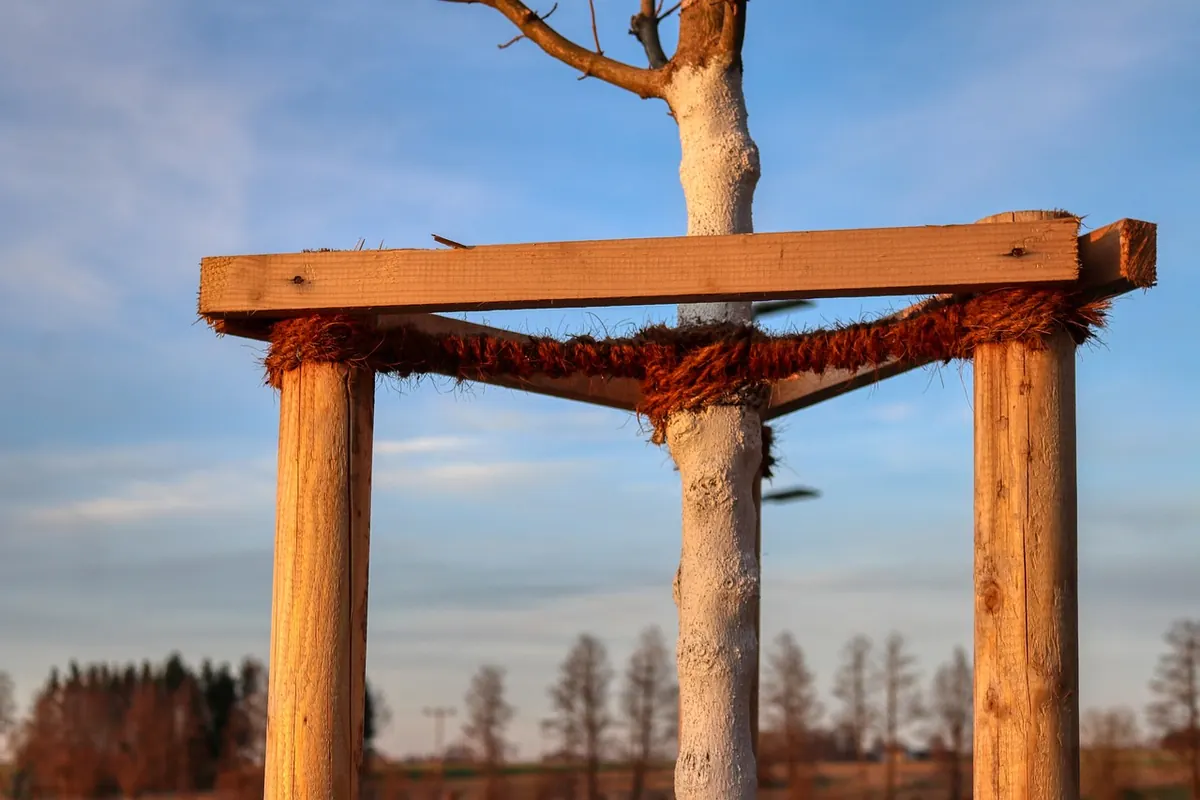
A young pomegranate needs help staying upright more than it needs shaping. Drive a sturdy stake — one and a half metres is plenty — into the undisturbed soil outside the root ball, then tie the trunk to it with soft twine or webbing in a loose figure-of-eight. The loop should hold the tree steady without strangling it as the trunk thickens. Two stakes either side of the root ball work even better in windy sites.
In hot climates, paint the young trunk with a diluted whitewash or wrap it with a light shade band for the first summer. Thin bark on a newly planted tree scorches easily, and a sunburnt trunk rarely recovers cleanly.
For the first winter, mound a little soil around the base and wrap the trunk if hard frosts are likely. Most fruiting cultivars handle brief dips to around minus twelve degrees once established, but a young tree in its first cold season has far less margin. Remove the stake after two growing seasons, or as soon as the trunk stands firm on its own.
The First Season After Planting
Water deeply and less often. A thorough soaking every week to ten days in dry weather beats a daily sprinkle, because it trains roots downward where the soil stays cool. In a cool spring, back off entirely until new growth appears.
Resist the urge to feed. Wait until you see active growth in late spring, then give a light application of a balanced fertiliser, and nothing more until the following year. Prune only what is dead, damaged or crossing. Pomegranates naturally grow as a multi-stemmed shrub, and you can either keep three or four strong stems or train a single trunk — decide in the first winter, then stick with it.
You may see flowers in the first summer. Pinching them off is optional but worthwhile: the tree puts that energy into roots instead. Expect a real crop in the second or third year from a healthy nursery tree, and something closer to a proper harvest from the fourth.
A Planting Worth Doing Once
Write the planting date on a label and tie it to the stake, along with the cultivar name. In three years, when the tree is fruiting and you can't remember whether it went in this bed in March or April, that scrap of plastic will tell you how fast it actually grew — and how much of the credit belongs to the way you prepared the hole.
After the first summer, pomegranates ask for very little: sun, an occasional deep soak, and a little patience in spring. Give them a good start and the rest is mostly waiting, which is the pleasant part.
Photo: planet_fox / Pixabay